WHEN ELVIS WALKED INTO RCA STUDIO B LIKE A KING — THEN MADE EVERYONE LAUG
Introduction
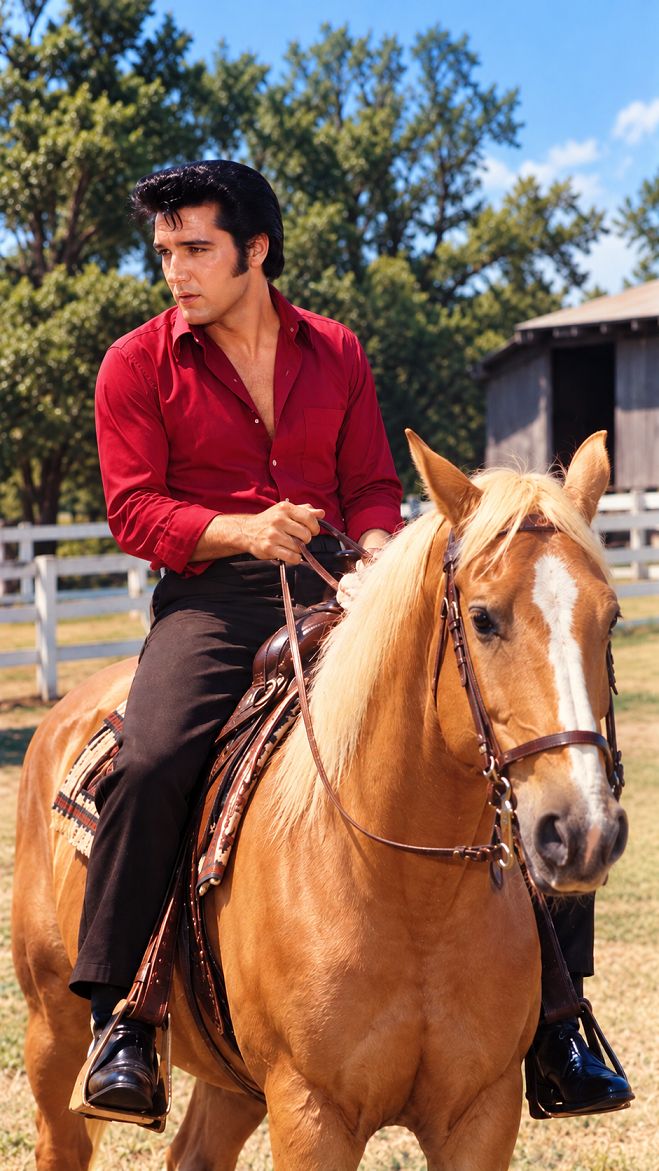
Some stories in music history survive because of a great recording. Others remain alive because someone who was there remembered the details. One such story comes from RCA Studio B in Nashville, where Elvis Presley arrived for a recording session in 1970 and immediately gave the musicians something they would never forget.
According to bassist Norbert Putnam, Elvis entered the studio wearing a flowing black cape and carrying an ornate cane. For a moment, the musicians simply watched. It was an entrance that seemed almost too dramatic for a recording studio, more like the arrival of royalty than a singer coming to work. Then Elvis reportedly broke the tension with a joke about whether the musicians could help him make a few phonograph records.
Just like that, the atmosphere changed. The dramatic entrance became a shared laugh, and the enormous public image of Elvis Presley seemed to disappear for a moment. He was no longer simply the legendary performer everyone knew. He was another musician standing in a room full of professionals, preparing to make a record.
That contrast says a great deal about Elvis Presley. He understood the power of appearance and knew exactly how much attention his presence could command. Yet he also understood that once the recording began, the cape and the cane meant very little. The microphone did not care how famous he was. The musicians still had to play, the arrangement still had to work, and the singer still had to deliver.
The Nashville sessions brought Elvis together with musicians including James Burton, David Briggs, and Norbert Putnam, players who understood the language of Nashville recording. Their work was part of a broader musical world that connected country, gospel, blues, rock and roll, and pop. Elvis had always moved naturally between those traditions, and the studio gave him a place to concentrate on interpretation rather than spectacle.
That is what makes this story more interesting than simply an amusing anecdote. Great recording sessions are conversations. A bass player responds to the drummer, a guitarist finds space around the vocal, a keyboard player adds color, and the singer listens to everything happening around him. The finished record may carry one famous name, but the sound is often created by many people working together.
Perhaps the most memorable detail is still the humor. Imagine Elvis walking through the door dressed like royalty, watching the musicians react, and then making them laugh before the work even began. It reveals a side of him that photographs and concert footage cannot fully capture. The public knew the King; the musicians also remembered the man who could make a room relax.
Once the music started, however, the image became secondary. The cape could create an entrance, but it could not create a great recording. The fame could fill a room, but it could not replace musical chemistry. What mattered was the voice, the musicians, the arrangement, and the song.
More than fifty years later, the scene remains remarkably easy to imagine: the studio door opens, Elvis walks in, the musicians stare, the room becomes tense for a moment, and then a joke breaks the spell. After that, everyone gets back to work.
That may be the most fitting way to remember Elvis. He could enter a room like royalty, but inside the studio he still had to prove himself through music. The cape announced the arrival of Elvis Presley. The recording revealed the musician.
And perhaps that is why this small Nashville story has lasted. Beneath the legend was a working artist who understood that when the lights fade and the conversation ends, the music always gets the final word.