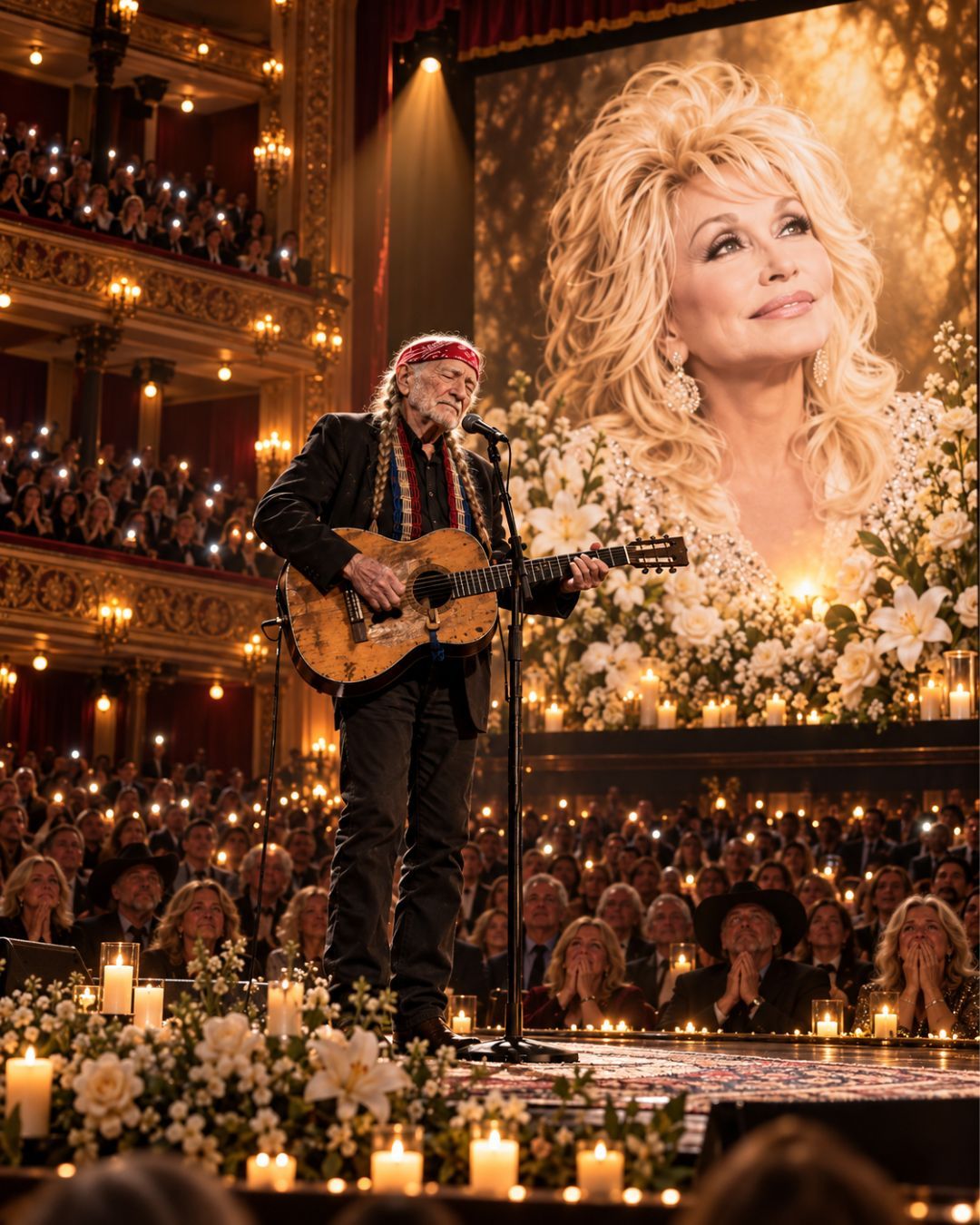
SHE DIDN’T BRING A HIT. SHE BROUGHT A HYMN — AND FOR A FEW MINUTES, THE ROOM FORGOT IT WAS TELEVISION.

It was supposed to be another polished night of country music television, the kind built around famous faces, carefully timed introductions, elegant gowns, and songs audiences already knew by heart. But when Carrie Underwood walked onto the stage and Vince Gill settled beside her with a guitar, something about the atmosphere immediately felt different. There was no need to introduce a new single. There was no attempt to manufacture a viral moment. Carrie had chosen something much older than either performer, something that had traveled across countries, churches, generations, funerals, revivals, and Sunday mornings long before either of them became famous. She had brought “How Great Thou Art.”
The hymn carried history into the room before Carrie sang a note. Its origins reach back to a nineteenth-century Swedish poem by Carl Boberg, with the song eventually traveling through translations and adaptations before becoming deeply familiar to English-speaking Christian audiences. In America, it became especially associated with evangelical gatherings and the Billy Graham crusades, where George Beverly Shea’s performances helped introduce it to enormous audiences. By the time Carrie and Vince approached it, “How Great Thou Art” was more than an old hymn. For countless Americans, it carried memories of wooden church pews, grandparents singing from hymnals, Sunday mornings, weddings, funerals, and moments when ordinary people reached for music because spoken words were not enough.
That history could have made the performance feel heavy. Instead, Vince made it feel intimate. He played without trying to compete with the voice beside him. There is a particular kind of confidence required for a musician of Vince Gill’s stature to understand that sometimes the greatest contribution is restraint. His guitar did not announce itself. It supported, answered, and left space. Every chord seemed to create another few inches of room for Carrie to tell the story.
And Carrie did not rush.
She began with control, allowing the melody to breathe. That mattered because everyone familiar with the hymn knew where it could eventually go. “How Great Thou Art” contains one of those melodies that can grow from something almost whispered into something enormous. A lesser performance might have treated the opening merely as preparation for the big vocal moment. Carrie treated the quiet passages as though they mattered just as much.
That changed everything.
For a few minutes, the television machinery seemed to disappear. The cameras were still moving. The lights were still carefully positioned. Producers were still watching clocks somewhere beyond the stage. But none of that seemed important anymore. The performance stopped feeling like a segment and began feeling closer to something private that thousands of people had somehow been permitted to witness.
Then Carrie’s voice began to rise.
Not suddenly, and not merely for volume. She allowed the song to build the way old hymns often do, accumulating emotional weight verse by verse. Vince remained beside her, steady and understated, his guitar providing the foundation while Carrie’s voice climbed above it. By the final stretch, she was no longer simply singing a familiar standard. She was releasing everything the song had been holding back.
The reaction in the room told its own story. Faces in the audience changed. The usual expressions people wear when they know a television camera may find them gave way to something more vulnerable. Naomi Judd was visibly moved, one of several reminders that the people watching were not simply celebrities evaluating another performance. Many of them had grown up with this music too. They knew what a hymn like this could carry.
That is important to remember about country music. Long before enormous arenas, LED screens, streaming numbers, and social media, much of the genre grew from homes, churches, porches, community gatherings, and families singing together. Gospel music and country music have always shared blood. The same artists who sang about heartbreak on Saturday night often grew up singing hymns on Sunday morning.
Carrie understood that tradition.
So did Vince.
And perhaps that is why their performance worked so powerfully. Neither appeared interested in modernizing the hymn simply to prove that they could. They trusted it. They trusted the melody. They trusted the words. Most importantly, they trusted silence.
When the final notes arrived, there was a brief feeling that applause itself might be an intrusion. That strange fraction of time after a truly powerful performance can be more revealing than the cheering that follows. Nobody wants to be the first person to break whatever has settled over the room.
Then the audience rose.
The applause came.
But something had already happened before it did.
For older viewers watching at home, the performance may have opened doors to memories that had little to do with Carrie Underwood or Vince Gill. Perhaps it brought back a mother singing in church. Perhaps it recalled a grandfather standing with a hymnal in weathered hands. Perhaps it returned someone to a small sanctuary where the piano was slightly out of tune and nobody cared. Perhaps it recalled a funeral where “How Great Thou Art” had been the only song capable of expressing what the family could not say.
That is the strange power of an old hymn.
You do not simply hear it. You hear everyone you once heard singing it.
Carrie brought the voice that night. Vince brought the guitar. But generations of listeners brought the memories.
And that was why the performance became larger than television.
There were no explosions required. No elaborate choreography was necessary. No clever introduction could have improved it. Two country artists stood beneath the lights and trusted a song that had survived for generations before either of them arrived.
For those few minutes, nobody seemed worried about charts, ratings, awards, or what would happen after the commercial break.
There was simply a woman singing, a man playing guitar, an old hymn, and a room becoming unexpectedly still.
Sometimes country music does not need to reinvent itself.
Sometimes it only needs to remember where it came from.
And on that night, Carrie Underwood and Vince Gill did exactly that.
She didn’t bring a hit. She brought a hymn.
And somewhere between the first quiet verse and the final towering note, the room forgot it was watching television.