The Controversy Explained: What Went Wrong for Elvis Presley — The Claims, Reactions, and Turning Point That Changed the…
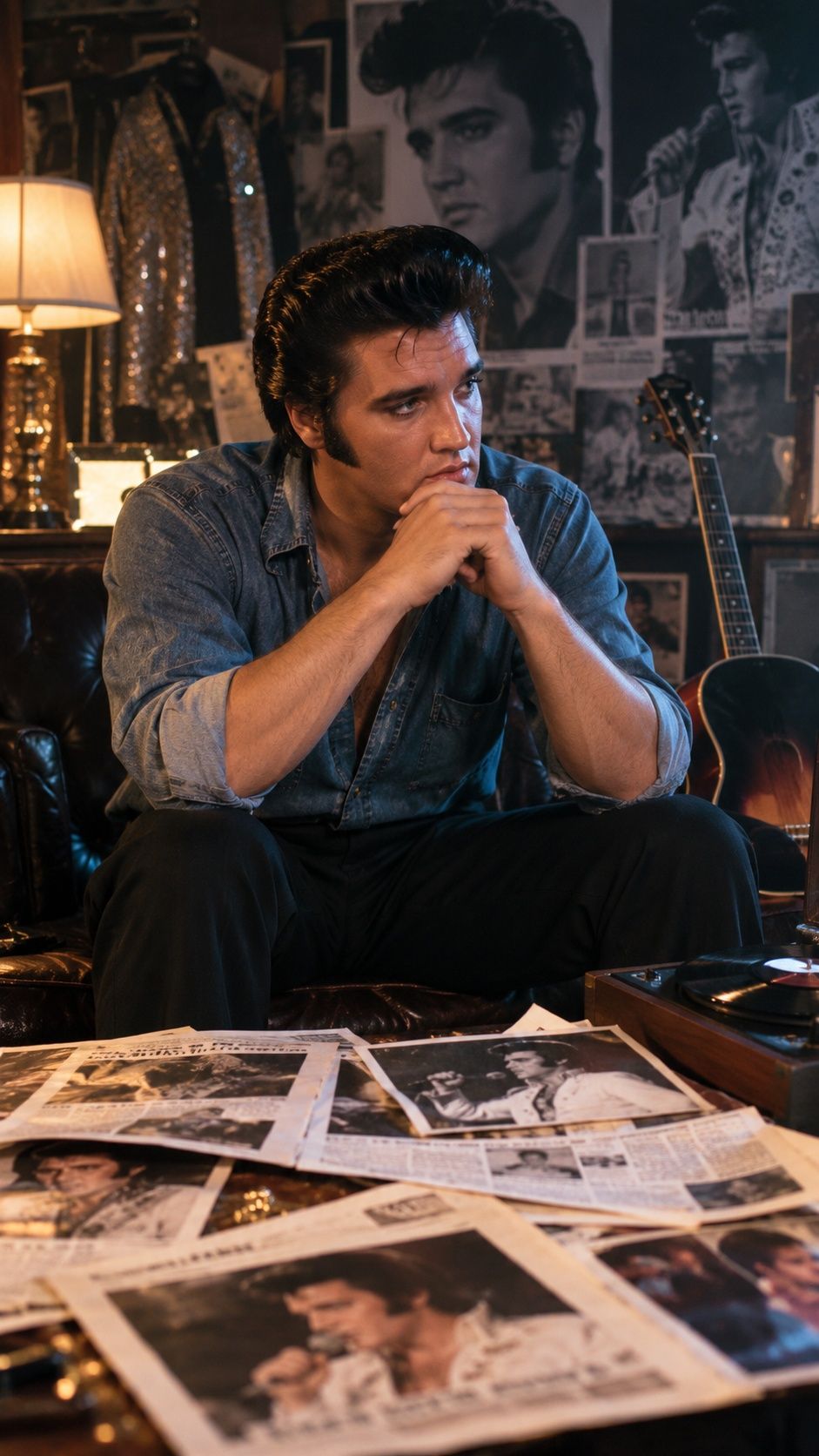
Few figures in American music carry a story as dramatic, complicated, and deeply human as Elvis Presley. He arrived like a thunderbolt, transformed popular culture, and became a symbol of rebellion, glamour, sexuality, and possibility. Yet behind the dazzling stage lights was a career increasingly shaped by forces that did not always serve the artist at its center.
The controversy surrounding Elvis is not really one story. It is a collision of competing explanations: Was he failed by an industry that valued money over artistic growth? Was his career constrained by Colonel Tom Parker, the manager who helped make him famous? Did Hollywood dilute his musical identity? Did relentless touring, personal isolation, prescription-drug dependence, and the enormous pressures of celebrity contribute to his tragic final years?
The answer is more complicated than any single villain or turning point.
Indeed, Elvis repeatedly demonstrated that the extraordinary performer was still inside the machinery. His 1968 television comeback proved that dramatically. For one remarkable moment, he seemed to reclaim control of his artistic identity. But the renaissance that followed was not permanent.
What happened next remains one of the most debated chapters in music history.
THE FIRST GREAT TURN: FROM REVOLUTIONARY MUSICIAN TO HOLLYWOOD STAR
When Elvis Presley exploded onto the national scene in the 1950s, his combination of rhythm and blues, country, gospel, charisma, and provocative performance style changed the commercial landscape of American music.
But after his military service, the trajectory shifted.
His manager, Colonel Tom Parker, increasingly emphasized films and commercial opportunities. Presley remained enormously successful, but many of his movies were formulaic, and his musical ambitions were frequently subordinated to the demands of the entertainment machine. Contemporary retrospectives have repeatedly identified this period as a central source of the later criticism surrounding his career.
The crucial distinction is that commercial success and artistic satisfaction were not necessarily the same thing.
Elvis could still make money while becoming increasingly frustrated with the material he was being asked to perform.
That tension would eventually become impossible to ignore.
THE PARKER QUESTION: MANAGER, PARTNER, OR CONSTRAINT?
No person occupies a more controversial position in the Elvis story than Colonel Tom Parker.
Parker undeniably played a major role in turning Elvis from a promising young performer into an international superstar. He understood publicity, contracts, television, merchandising, and the economics of celebrity at a level few managers of his era could match.
But the same relationship has also generated decades of criticism.
Parker’s management fees became particularly controversial, with historical investigations examining arrangements in which he received exceptionally large percentages of Presley’s earnings. His unusual personal circumstances also meant that Elvis never developed the kind of international touring career many other superstars enjoyed.
Yet portraying Parker as the sole architect of everything that went wrong oversimplifies the evidence.
Recent scholarship has emphasized that their relationship was more complicated than the familiar “evil manager destroys genius” narrative. Peter Guralnick, whose work has examined Parker’s personal papers, has argued that Parker’s influence over Elvis’s artistic decisions was sometimes less direct than popular mythology suggests.
That distinction matters.
Parker could shape the business surrounding Elvis without necessarily controlling every creative impulse inside him.
The tragedy is that both men became increasingly locked into a system that had once produced extraordinary success.
THE 1968 TURNING POINT: ELVIS TAKES THE STAGE BACK
Then came 1968.
By that point, Elvis’s career appeared dangerously stagnant. His movies had become predictable, younger audiences were embracing new cultural heroes, and the musical revolution he had helped create was moving forward without him.
Then Steve Binder entered the picture.
The producer and director of the television special reportedly gave Elvis an unusually blunt assessment of his career. Instead of treating him like an untouchable legend, Binder treated him like an artist who still had something to prove. That honesty helped establish a creative partnership that would change the direction of the project.
The resulting ’68 Comeback Special became one of the defining moments of Presley’s career.
Instead of appearing as a sanitized television personality, Elvis returned to the raw energy of his early years. He sang, joked, moved, sweated, and interacted with musicians in a way that reminded audiences why he had become famous in the first place.
Most importantly, he looked engaged again.
The special was a commercial and artistic success, and it helped lead to a renewed period of recording and live performance. Songs such as In the Ghetto and Suspicious Minds demonstrated that Presley could still produce important contemporary music.
For a moment, the conversation changed from “What happened to Elvis?” to “Elvis is back.”
LAS VEGAS: THE COMEBACK BECOMES A NEW MACHINE
The next chapter was Las Vegas.
In 1969, Elvis returned to live performance with a major engagement at the International Hotel. The response was enormous, and the shows helped establish a new version of Presley: older, more commanding, extravagantly dressed, and increasingly associated with the spectacle of the Las Vegas stage.
This period is important because it reveals another paradox.
Las Vegas revitalized Elvis.
But it also created a demanding performance cycle that would become increasingly difficult to sustain.
The performer who once represented youthful rebellion had become a monumental entertainment institution.
The jumpsuits became more elaborate. The concerts became major productions. The expectations became enormous.
And the physical and psychological demands of maintaining that image increased.
THE CLAIMS ABOUT DRUGS AND DECLINE
The most painful part of the Elvis story concerns his health and prescription-drug dependence.
By the 1970s, concerns about his physical condition and increasingly erratic performances became impossible to separate from the larger discussion about his lifestyle. Historical accounts describe escalating problems involving prescription medications, weight, exhaustion, and the pressures surrounding his work schedule.
However, sensational explanations can obscure an important reality.
Elvis’s decline was not simply a story of “drugs destroyed a superstar.”
It involved multiple overlapping pressures: chronic health problems, professional demands, personal isolation, changing relationships, enormous financial expectations, and a culture in which prescription medication was widely available to entertainers.
The medical circumstances surrounding his death have also been discussed and interpreted in different ways. Contemporary reporting after his death described significant cardiovascular problems, including an enlarged heart, atherosclerosis, and hypertension.
That evidence complicates simplistic narratives about what ultimately happened to him.
THE REACTION: WHY FANS NEVER STOPPED DEFENDING HIM
Perhaps the most revealing aspect of the controversy is how fiercely fans resisted the idea that the final years should define Elvis Presley.
To critics, the late-period performances could symbolize a superstar trapped inside an increasingly unsustainable lifestyle.
To devoted fans, they represented something else: a human being continuing to walk onto the stage despite extraordinary pressures.
Both perspectives exist because Elvis’s final years contained contradiction.
There were performances where his old charisma could still suddenly explode into view. There were also moments that revealed how far his physical condition had deteriorated.
That inconsistency makes his final chapter difficult to reduce to a single interpretation.
WHAT REALLY WENT WRONG?
The most useful way to understand Elvis’s decline may be to stop looking for one culprit.
Colonel Tom Parker mattered.
Hollywood mattered.
The relentless economics of celebrity mattered.
Prescription drugs mattered.
Elvis’s own decisions mattered.
His health mattered.
And perhaps most importantly, the enormous mythology surrounding Elvis mattered.
Once an artist becomes “the King,” ordinary human limitations become almost impossible for the public to accept.
Elvis was expected to remain permanently larger than life.
But the person behind the image was aging.
The 1968 comeback demonstrated that the artistic instinct had never completely disappeared. His later career demonstrated that extraordinary talent could coexist with profound personal and professional difficulties.
That is why the Elvis controversy remains so compelling decades later.
The story is not simply about a star who fell.
It is about an artist who rose so high that the world struggled to understand what happened when he became human again.
And perhaps that is the ultimate turning point in the conversation about Elvis Presley.
Instead of asking only how the King lost his throne, we can ask a more revealing question:
How much of Elvis was ever truly allowed to belong to Elvis?
That question has no simple answer.
But it is precisely why his story continues to resonate.