ONE FINAL SALUTE BENEATH THE WHITE HAT — ALAN JACKSON’S FAREWELL TURNED A STADIUM INTO A LIFETIME OF…
Introduction

There are concerts that end when the final note disappears, the lights begin to fade, and the audience slowly makes its way home. Then there are concerts that feel much bigger than a single evening—moments that seem to close an entire chapter of a musical life. For thousands of longtime country fans, Alan Jackson’s farewell from full-length touring carried exactly that kind of significance.
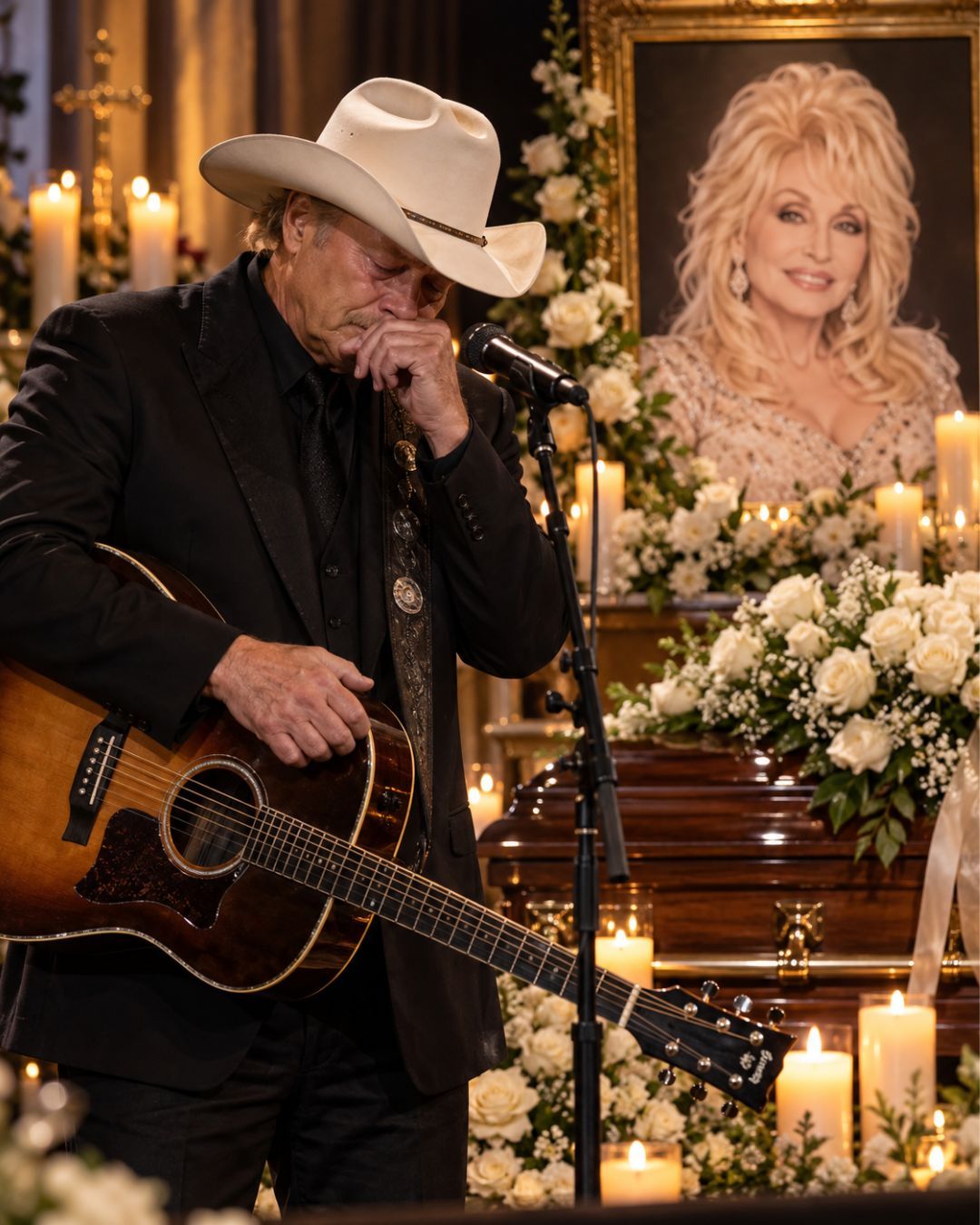
Beneath the familiar white cowboy hat, Jackson stood before a massive audience not simply as a celebrated country singer, but as a storyteller whose music had accompanied several generations through the ordinary and extraordinary moments of life. The setting may have been a stadium, but the emotions were remarkably personal. Every familiar melody seemed to bring back a different memory.
And then came the salute.
It was a simple gesture. Alan Jackson raised his hand toward the crowd, acknowledging the people who had spent decades singing along with him. There was nothing complicated about it, and perhaps that was precisely why it felt so powerful. After a career built largely on honesty, restraint, and unmistakable country character, Jackson did not need an elaborate farewell.
The audience already understood.
For many longtime listeners, Alan Jackson is connected to a particular period of country music that feels increasingly precious. His career emerged during a transformative era, when traditional country sounds were still firmly at the center of mainstream radio. His songs carried the warmth of steel guitars, straightforward melodies, memorable choruses, and stories about people trying to make sense of family, home, faith, change, growing older, and the passage of time.
That authenticity became one of his greatest strengths.
Songs such as “Remember When,” “Drive (For Daddy Gene),” “Where Were You (When the World Stopped Turning),” “Chattahoochee,” and “Gone Country” reached listeners in very different ways. Some captured youthful energy and small-town memories. Others reflected on family, responsibility, loss, national tragedy, or the inevitable movement of time. Taken together, they form something close to a musical diary of American life across several decades.
That is why a farewell from the touring stage carries such unusual emotional weight.
People do not simply remember Alan Jackson’s songs. They remember where they were when they heard them.
A particular song may bring back a road trip with parents. Another may recall a family gathering or an important anniversary. One may remind someone of a friend who is no longer there. Another may immediately transport a listener back to a summer, a hometown, or a simpler period of life.
This is the extraordinary relationship between country music and memory.
A great country song does not remain confined to the recording studio. It enters people’s lives.
Over the course of his career, Jackson became one of the artists who understood that better than most. His music rarely depended on unnecessary extravagance. Instead, he trusted the strength of a good story, a memorable melody, and a voice that sounded sincere. His approach allowed listeners to recognize pieces of themselves in the songs.
By the time of this farewell, Jackson’s achievements were already firmly established. He had accumulated 35 No. 1 songs and sold nearly 60 million records worldwide, numbers that demonstrate the extraordinary reach of his career. But statistics alone cannot explain what happened inside that stadium.
The real story was in the audience.
More than 50,000 fans gathered together, representing different ages and different generations. Some had followed Jackson since the beginning of his career. Others discovered his music later through parents, grandparents, radio stations, recordings, or family playlists.
That generational connection is perhaps one of Jackson’s most important achievements.
A child who heard “Chattahoochee” decades ago could eventually introduce the same song to a grandchild. Someone who once listened to Jackson on a cassette or CD could later hear those familiar melodies through modern speakers while driving with their own family. The technology changed. The world changed. But the songs remained.
And that is what made the sight of Jackson beneath the white cowboy hat so meaningful.

The hat itself has become part of his visual identity, but on a night like this, it seemed to represent something more. It recalled an era when country music could be proudly traditional without apologizing for it. Jackson helped bring that sensibility to a huge audience while remaining connected to the musical roots that shaped him.
His farewell therefore felt less like the ending of a career than the closing of a particularly important chapter.
There is also something deeply appropriate about the simplicity of his final salute.
Jackson’s greatest songs have often dealt with the passing of time. “Remember When” is perhaps the clearest example, looking back across the stages of a life and recognizing how quickly the years can disappear. The song’s emotional strength comes from its understanding that memories become more valuable precisely because time continues moving forward.
That theme made the farewell feel almost inevitable.
The audience had come to celebrate the music, but they were also confronting the reality that certain chapters do eventually close.
The lights may eventually go down.
The applause may eventually become quiet.
The touring schedule may eventually end.
But the music remains.
It remains in old recordings, in family collections, in radio broadcasts, in concert memories, and in the voices of people who still know every word. For older country fans especially, that permanence can feel remarkably comforting.
Because Alan Jackson’s legacy is not simply measured by awards, chart positions, or record sales.
It is measured by memory.
It is measured by the people who heard his songs during important moments of their lives and carried those songs forward. It is measured by parents who introduced his music to their children, and by children who later discovered why those songs mattered so much to their parents.
That is what transforms a successful singer into a lasting storyteller.
So when Alan Jackson raised his hand beneath that white hat, the gesture said far more than goodbye.
It was a thank-you.
A thank-you to the fans who stayed with him for decades.
A thank-you to the musicians and songwriters who helped build the journey.
And perhaps most importantly, a thank-you to the songs themselves—the songs that allowed one man’s voice to become part of millions of people’s memories.
For four decades, Alan Jackson gave country music something increasingly rare: a sense that simplicity could still be powerful, that tradition could still feel fresh, and that a well-told story could remain meaningful long after the spotlight disappeared.
His touring chapter may have reached its final pages.
But the story is far from over.
The stadium will eventually empty. The stage will eventually be dismantled. The lights will eventually go dark.
Yet somewhere, a radio will play “Remember When.”
Somewhere, a family will sing along to “Chattahoochee.”
Somewhere, an older listener will hear “Drive (For Daddy Gene)” and suddenly remember someone they loved.
And somewhere, beneath the familiar sound of a country song, that white cowboy hat will still seem to be there.
Because Alan Jackson did not simply perform the soundtrack of a generation.
He became part of its memories.