THE NIGHT AMERICA STOPPED TO WATCH ELVIS
Introduction
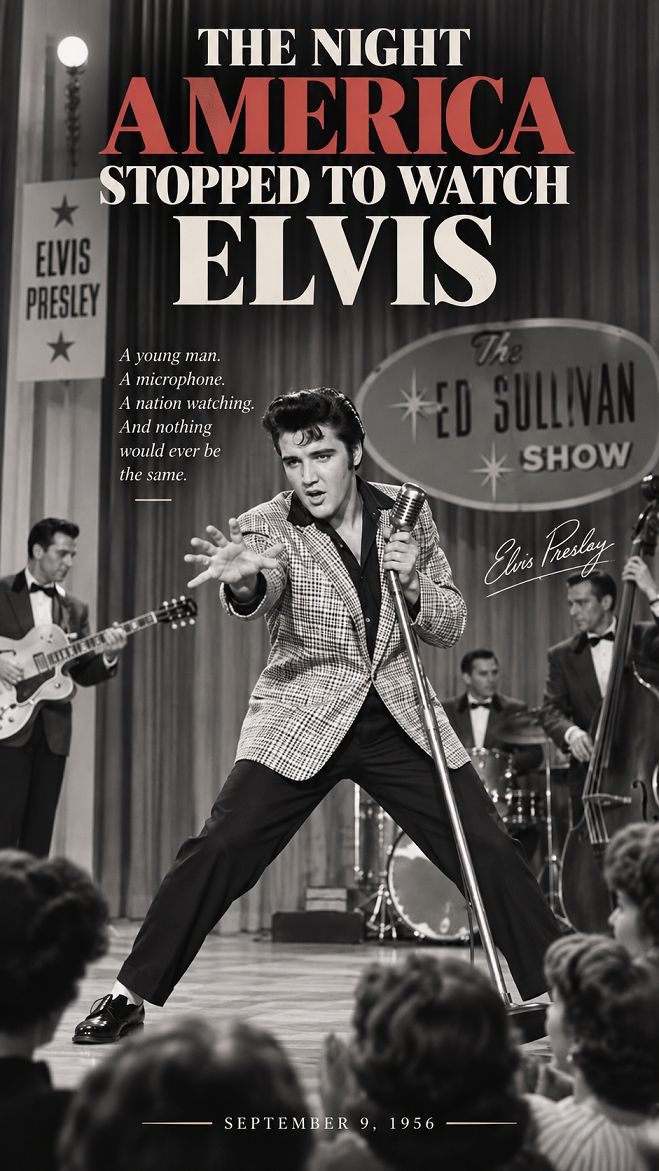
On the night of September 9, 1956, something extraordinary happened in American living rooms.
Across the country, families gathered around their television sets to watch a young singer who had already become one of the most talked-about figures in popular music.
His name was Elvis Presley.
He was only 21 years old.
But by that point, Elvis was no longer simply a promising young singer from Memphis. He had become a national sensation — particularly among teenagers, who saw something completely new in him.
His voice was different.
His appearance was different.
And when he stepped onto a stage, he performed with an energy that television audiences had rarely seen before.
For many adults, Elvis was difficult to understand.
For young Americans, he was impossible to ignore.
That evening, Elvis made his first appearance on The Ed Sullivan Show, one of the most important television programs in America at the time.
The significance of the moment was enormous.
Television was still a relatively young medium, but programs such as Sullivan’s could bring an entertainer directly into millions of homes at once.
There was no YouTube.
No streaming service.
No social media.
No way to watch the performance whenever you wanted.
If you wanted to see Elvis that night, you had to be sitting in front of your television when the program aired.
And millions of Americans were.
Elvis performed songs including “Don’t Be Cruel,” “Love Me Tender,” “Ready Teddy,” and “Hound Dog.”
For his young fans, it was thrilling.
For some parents, it was something else entirely.
Elvis had already attracted controversy because of his energetic stage movements and unmistakable style. His performances challenged the expectations of what a young male singer was supposed to look and sound like on American television.
That tension became part of the phenomenon.
The more people argued about Elvis, the more people wanted to see him.
And on that September night, an enormous television audience got the opportunity.
Estimates put the audience at roughly 60 million viewers — an extraordinary number for the television era.
Think about what that meant.
Millions of people, separated by hundreds or even thousands of miles, were watching the same young man at almost exactly the same moment.
Today, entertainment is everywhere.
We can watch a concert from decades ago on our phones. We can replay a performance whenever we want. We can share a clip with millions of people in seconds.
But America in 1956 was different.
A television program could become a national gathering place.
And Elvis understood something that few performers of his generation understood so quickly: television could turn a singer into a cultural event.
His appearance on The Ed Sullivan Show helped introduce Elvis to an enormous audience that extended far beyond the teenagers already buying his records.
Suddenly, parents who had only heard about the controversial young singer could see him for themselves.
Some were impressed.
Some were confused.
Some were probably wondering what had happened to popular music.
But almost nobody could ignore him.
That is what makes the moment so fascinating more than seven decades later.
Elvis did not simply perform four songs that evening.
He became part of the national conversation.
For young Americans, he represented a new generation and a new kind of popular culture. His music drew from multiple American traditions, including country, blues, gospel, and rhythm and blues.
He did not invent all of those sounds.
But he brought them together in a way that felt fresh, exciting, and unmistakably his own.
And television gave that sound a face.
A hairstyle.
A personality.
A presence.
That night in 1956, America wasn’t just discovering a singer.
America was discovering Elvis Presley on a scale that had never happened before.
Years later, it is easy to look back at the footage and wonder what all the excitement was about.
But that is precisely the point.
History often feels ordinary while it is happening.
The people sitting in those living rooms did not know they were watching a moment that would eventually become part of American music history.
They were simply watching television.
Perhaps a teenager was sitting on the floor.
Perhaps a father was shaking his head.
Perhaps a mother was wondering why her children were so fascinated by this young man from Tennessee.
And perhaps, somewhere in millions of homes, someone was seeing Elvis for the very first time.
That is what makes the night memorable.
Before the internet, before streaming, before social media turned every performance into an instant global event, there was television.
And on September 9, 1956, millions of Americans turned on their sets and watched the future of popular music walk into their living rooms.
They weren’t just watching Elvis Presley perform.
They were watching a cultural phenomenon take shape before their eyes.
And for one unforgettable night, America stopped to watch.